

John Wanamaker, a pioneer in marketing, famously said over a century ago: “Half the money I spend on advertising is wasted; the trouble is I don’t know which half.”
For decades, marketers have chased the Holy Grail of answering that exact question. Today, the solution lies in a discipline known as marketing attribution. However, as digital ecosystems become infinitely more complex, finding out exactly what made a customer click “buy” is no longer as simple as looking at a single billboard or a solitary Facebook ad.
Modern consumers are researchers. They discover your brand on TikTok, read a review on a blog, click a retargeting ad on Google, subscribe to your newsletter, and finally make a purchase via an email link on their desktop three weeks later. How do you decide which of those touchpoints deserves the credit for the sale?
This comprehensive guide will demystify the complexities of attribution. We will explore everything from basic models to advanced analytics, helping you understand how to credit your marketing efforts accurately and drive sustainable growth.

What is Marketing Attribution?
At its core, marketing attribution is the analytical science of determining which marketing tactics are contributing to sales or conversions. It is the process of assigning value to digital interactions that a consumer has with your brand across various channels before they finally become a customer.
Without a solid attribution strategy, you are flying blind. You might be pouring thousands of dollars into a social media campaign that generates a lot of clicks but zero actual revenue, while starving a quiet email sequence that is doing all the heavy lifting.
By correctly attributing conversions, brands can identify exactly what works, what doesn’t, and where their next marketing dollar should be spent.
The Role of Customer Journey Mapping
You cannot attribute value if you don’t know the path your buyer takes. This is where customer journey mapping comes into play. A customer journey map is a visual representation of the process a prospect goes through to achieve a goal with your company.
When you align your attribution data with a well-researched journey map, you transition from simply counting clicks to genuinely understanding human behavior. You begin to see that a top-of-funnel blog post isn’t a failure because it didn’t generate a sale; rather, it was the critical first step in a much longer, multi-channel journey.
The Core Attribution Models Explained
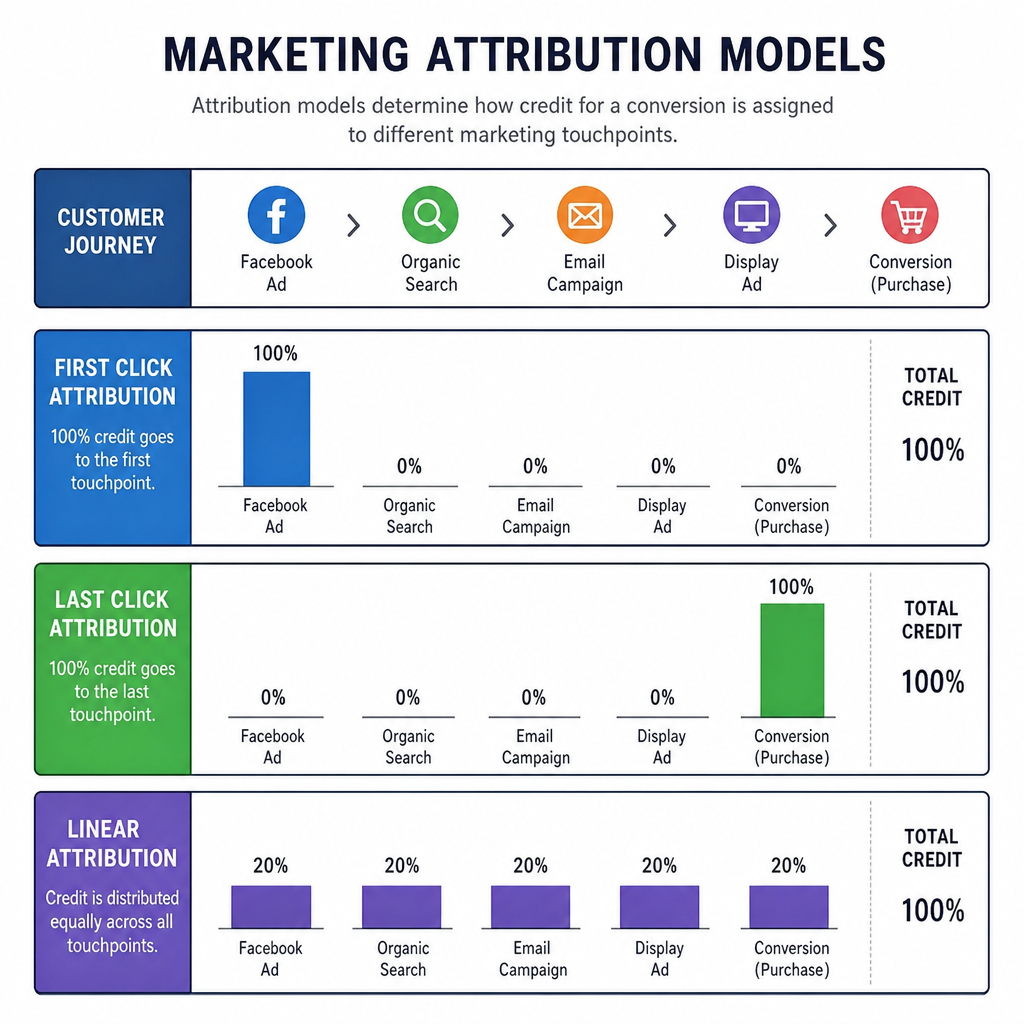
To make sense of the data, marketers use “attribution models”—a set of rules that determines how credit for sales and conversions is assigned to touchpoints in conversion paths. Choosing the right model depends heavily on your business type, sales cycle length, and marketing goals.
Single-Touch Models: Keeping It Simple
Single-touch models give 100% of the conversion credit to one single marketing interaction. While easy to set up, they are often criticized for oversimplifying the modern buyer’s journey.
When comparing first click vs last click models, you are essentially looking at the two extremes of the customer journey:
- First-Click Attribution: This model gives 100% of the credit to the very first interaction a customer had with your brand.
- Best for: Brands focused strictly on top-of-funnel brand awareness and rapid audience growth.
- The flaw: It completely ignores the nurturing process. If a customer finds you via an SEO article but takes six months and ten more interactions to buy, the article gets all the glory, and the hard-working retargeting ads get nothing.
- Last-Click Attribution: Historically the default for tools like Google Analytics, this model gives 100% of the credit to the final touchpoint before the sale.
- Best for: Transactional businesses with very short sales cycles (e.g., low-cost e-commerce goods).
- The flaw: It ignores how the customer found you in the first place. It’s like giving the person who swiped the credit card all the credit for a sale, ignoring the salesperson who spent hours pitching the product.
Multi-Touch Models: Sharing the Wealth
Multi-touch models distribute the credit across multiple interactions, providing a more holistic view of mapping the full buyer journey.
- Linear Attribution: This model distributes credit equally across every single touchpoint. If a customer interacts with an Instagram ad, a Google Search, and an Email before buying, each channel gets 33.3% of the credit.
- The debate: When looking at linear versus time decay weighting, linear is often seen as the “participation trophy” of attribution. It’s fair, but it doesn’t highlight which touchpoints were actually the most influential.
- Time Decay Attribution: This model assigns more credit to the touchpoints that occurred closest in time to the actual conversion. The email clicked an hour before purchase gets heavy credit, while the display ad clicked three weeks ago gets a tiny fraction.
- Best for: Long sales cycles where you want to understand what exactly pushes a hesitant buyer over the finish line.
- Position-Based (U-Shaped) Attribution:U-shaped position based reporting is a favorite among B2B marketers. It assigns 40% of the credit to the first touchpoint (discovery), 40% to the last touchpoint (conversion), and divides the remaining 20% evenly among all the nurturing touchpoints in the middle.
- Best for: Lead generation businesses that highly value both the initial acquisition and the final conversion action.
Advanced Models: The Data-Driven Approach
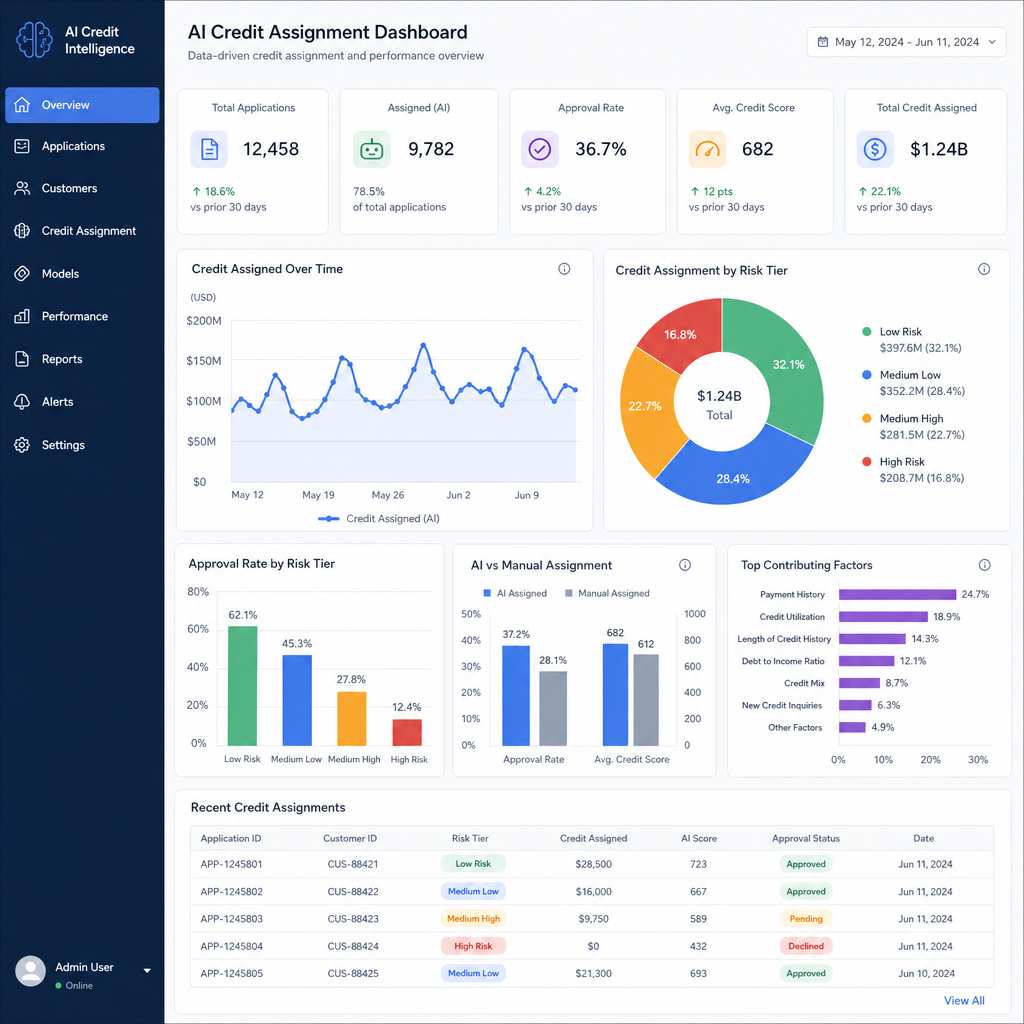
As marketing budgets scale, manual rules-based models (like those above) often fall short. Enter algorithmic data-driven credit assignment.
Instead of relying on rigid, pre-defined rules, data-driven attribution uses machine learning and historical data to calculate the exact fractional contribution of each touchpoint. The algorithm looks at both converting and non-converting paths to determine the true statistical probability that a specific ad or email led to a sale. If the algorithm notices that users who see a specific YouTube ad are 30% more likely to convert than those who don’t, it adjusts the credit accordingly.
Overcoming Modern Tracking Challenges
Understanding models is one thing, but applying them in the real world is becoming increasingly difficult. Many marketers today find themselves asking in frustration: why is conversion tracking inaccurate?
The reality is that the digital landscape is fracturing. A user might click an ad on their smartphone while on the train, browse your website on their work laptop, and finally make the purchase on their home tablet using a different email address. Tracking this fragmented identity is a logistical nightmare.
The Impact of Privacy Changes
Beyond device-hopping, the biggest hurdle today is the impact of privacy changes on tracking.
Over the last few years, consumer privacy has taken center stage. Apple’s iOS 14 update introduced App Tracking Transparency (ATT), requiring apps to ask users for permission to track them across other companies’ apps and websites. Unsurprisingly, the majority of users opted out.
Simultaneously, global regulations like GDPR in Europe and CCPA in California have strictly regulated how data can be collected. Furthermore, the impending deprecation of third-party cookies by major browsers means that following a user from site to site is becoming technologically impossible in many scenarios.
This loss of signal means attribution models that rely entirely on pixel tracking and cookies are losing their accuracy. Marketers are seeing “dark social” and direct traffic numbers inflate artificially because the tracking link broke somewhere along the journey.
Strategic Measurement: How to Adapt
To survive in a privacy-first world, marketers must adapt their measurement strategies. You can no longer rely on a single tracking pixel. Instead, you need a robust, multi-layered approach to measurement.
Multi-Touch Attribution (MTA) vs Media Mix Modeling (MMM)
When building a resilient measurement framework, it is crucial to understand the difference between multi-touch vs media mix modeling. They are entirely different methodologies that solve the same overarching problem.
- Multi-Touch Attribution (MTA): This is a bottom-up approach. It tracks individual users across digital touchpoints to see the specific path they took. It is highly granular, allowing you to see which specific ad creative or email subject line drove a sale. However, as discussed, it is highly vulnerable to privacy updates and cookie loss.
- Media Mix Modeling (MMM): This is a top-down, macroeconomic approach. MMM doesn’t track individual users or use cookies. Instead, it uses historical aggregate data (how much you spent on TV, Facebook, Google, alongside external factors like seasonality and economic trends) and runs statistical regressions to determine how those inputs correlate with sales spikes.
The modern solution? Triangulation. Forward-thinking brands are no longer choosing between the two. They use MMM for high-level budget allocation and MTA (using first-party data) for granular, day-to-day campaign optimization.
Proving True Value with Incrementality
Because tracking is imperfect, how do you know if an ad actually caused a sale, or if the customer was going to buy anyway? This is where incrementality testing in digital advertising becomes vital.
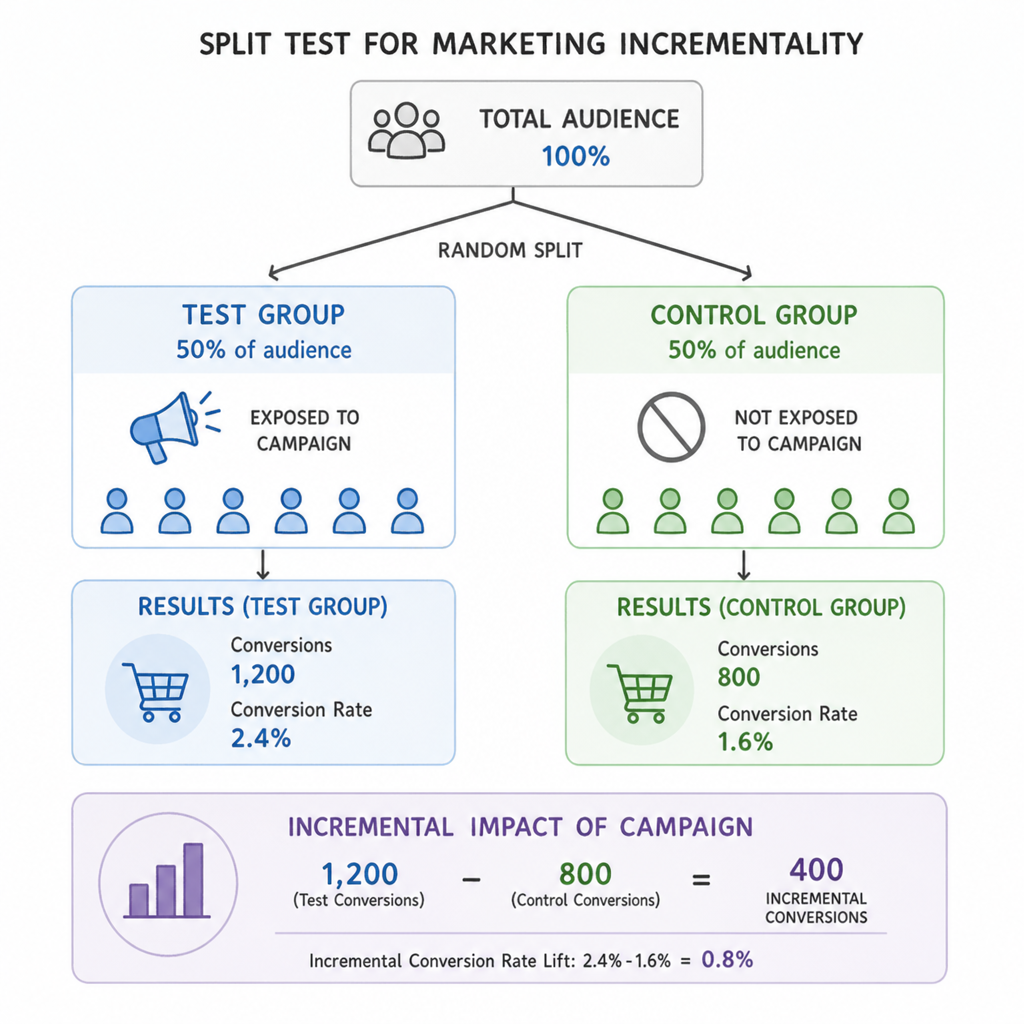
Incrementality testing involves creating a randomized controlled experiment. You take your target audience and split them into two groups:
- The Test Group: Sees your ad.
- The Holdout (Control) Group: Does not see your ad (or sees a placebo ad).
By measuring the difference in conversion rates between the two groups, you can determine the incremental lift provided by the ad. If both groups buy at the exact same rate, your ad spend is entirely wasted—even if your attribution software claims the ad is generating high ROI! Incrementality testing acts as the ultimate truth-teller, validating the data your attribution models produce.
Mastering the Data: Tracking and Integration
To make any attribution model work, you need high-quality data. If you feed garbage data into a sophisticated machine-learning algorithm, you will get garbage insights in return.
Figuring Out How to Track Conversion Paths
Learning how to track conversion paths effectively requires setting up a solid technical foundation. Here are the best practices for modern tracking:
- Standardize UTM Parameters: UTM (Urchin Tracking Module) codes are snippets of text added to the end of a URL. They tell your analytics software exactly where a click came from (e.g., source=facebook, medium=cpc, campaign=spring_sale). Without strict, standardized UTM naming conventions across your entire company, your conversion paths will be a messy, unreadable puzzle.
- Server-Side Tracking: Because client-side tracking (browser pixels) is being blocked by ad blockers and privacy browsers (like Safari and Brave), marketers are moving to server-side tracking. This means your website sends data directly from your web server to your analytics platform, bypassing the user’s browser restrictions and creating a much more reliable data stream.
- First-Party Data Capture: Encourage users to log in or provide their email address as early in their journey as possible (e.g., offering a discount code in exchange for an email). Once a user is authenticated, you can track their behavior across different devices flawlessly using their internal user ID.
The Importance of Cross-Channel Data Integration
Customers don’t live in a single channel, and neither should your data. One of the biggest mistakes companies make is analyzing their marketing in silos. The Facebook team looks at Facebook Ads Manager, the search team looks at Google Ads, and the email team looks at Mailchimp. Because every platform wants to claim credit to justify your spend, adding up the reported conversions from all these silos usually results in a number far higher than your actual total sales!
To fix this, you need cross-channel data integration.
This involves pulling data from every single marketing platform, your CRM (Customer Relationship Management) system, and your e-commerce platform, and funneling it into a centralized data warehouse (like Google BigQuery or Snowflake). Once the data is centralized, an attribution tool can deduplicate the conversions—ensuring that a single sale is only counted once—and fairly distribute the credit across the channels.
By actively tracking customer touchpoints in a unified environment, you gain a single source of truth that the entire company can agree on.
Maximizing ROI and Budget Allocation
The ultimate goal of marketing attribution is not just to create pretty charts; it is to drive business growth.
Measuring Return on Ad Spend (ROAS) Correctly
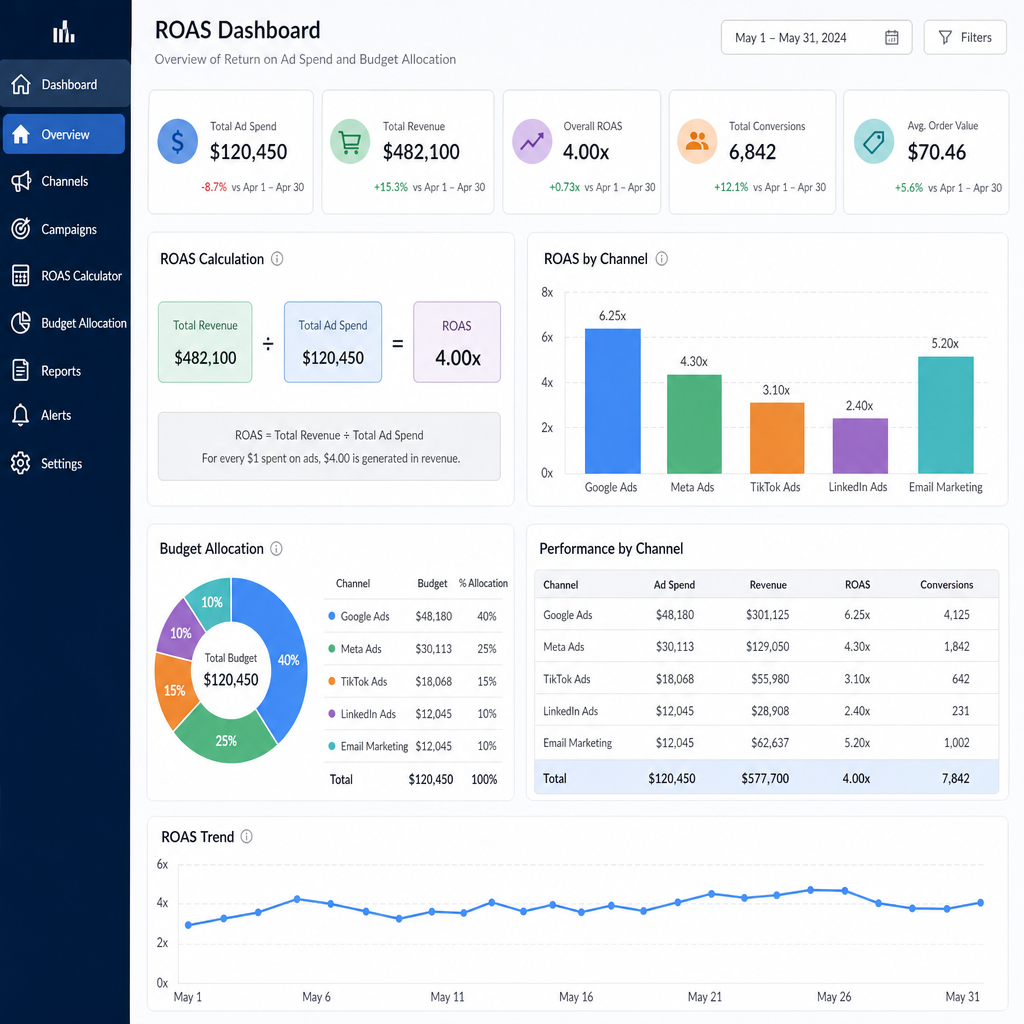
Measuring return on ad spend (ROAS) is the primary metric marketers use to gauge campaign success. ROAS is simply the total revenue generated by a campaign divided by the cost of that campaign.
However, ROAS is highly dependent on your attribution model. Imagine you spend $1,000 on a Facebook retargeting campaign and $1,000 on a Google Search discovery campaign. The resulting sales total $5,000.
- Under a Last-Click model, Facebook might get 100% of the credit. Your Facebook ROAS looks like an incredible 5:1, while Google looks like a 0:1 failure.
- Under an Algorithmic model, you might find that Google actually initiated 80% of those journeys. Suddenly, your Google ROAS is 4:1 and Facebook is 1:1.
By using the correct attribution model, you prevent yourself from accidentally turning off top-of-funnel campaigns that are secretly fueling your bottom-of-funnel success.
Optimizing Marketing Budget Allocation
Once you have an accurate picture of your ROAS across the entire funnel, optimizing marketing budget allocation becomes a mathematical exercise rather than a guessing game.
Attribution allows you to:
- Identify Waste: Quickly spot campaigns, keywords, or creatives that are burning budget without contributing to any part of the customer journey.
- Scale Winners: Identify hidden gems—like a middle-of-funnel webinar—that are quietly assisting in a massive number of conversions, and inject them with more funding.
- Balance the Funnel: Ensure you have the right mix of budget going toward brand awareness (to feed the top of the funnel) and direct response (to harvest the bottom of the funnel).
When budget allocation is powered by accurate attribution data, marketing transforms from a company expense into a predictable revenue generator.
Looking to the Future: Tools and Software
As we look toward the future, the technology powering attribution is evolving at breakneck speed. The top marketing attribution software 2026 will look vastly different from the tools we used a decade ago.
Future-proof attribution tools are heavily pivoting away from cookie-based tracking and moving toward predictive analytics and AI. We can expect upcoming software platforms to seamlessly integrate MTA and MMM into unified dashboards. These platforms will use machine learning to fill in the “blind spots” created by privacy laws, predicting user behavior through advanced probabilistic modeling rather than deterministic tracking.
Furthermore, these tools will offer real-time incrementality testing built directly into the platform, allowing marketers to run holdout tests with a single click and automatically adjust bids based on the true incremental value of an ad.
When evaluating software today, look for platforms that emphasize first-party data integrations, server-to-server tracking capabilities, and robust privacy compliance. The best tools are the ones that help you map the journey holistically rather than just relying on outdated browser cookies.
Conclusion
Understanding marketing attribution is no longer optional for businesses that want to scale efficiently; it is an absolute necessity.
In a world where consumer journeys are complex, multi-device, and heavily protected by privacy regulations, the old ways of simply looking at the last click are dead. Modern marketing requires a sophisticated approach to data.
By mastering the various models—from understanding the nuances of U-shaped reporting to leveraging data-driven algorithms—you can finally shine a light on the dark corners of your marketing funnel. Combine this with strategic media mix modeling, rigorous incrementality testing, and centralized data integration, and you will unlock unprecedented clarity.
When you can accurately trace the path from the first touchpoint to the final sale, you don’t just solve John Wanamaker’s century-old problem. You empower your brand to spend smarter, scale faster, and connect with your customers exactly when and where it matters most.
