

The landscape of marketing is shifting at an unprecedented pace. Just a few years ago, adopting artificial intelligence was considered a luxury reserved for massive enterprise brands with bottomless budgets. Today, digital marketing in the era of AI is an absolute necessity for businesses of all sizes looking to remain competitive, agile, and relevant.
We have entered an age where data flows constantly, consumer expectations are sky-high, and the margin for error in campaign targeting is razor-thin. To navigate this complex environment, modern marketers must look beyond basic automation and embrace intelligent systems capable of learning, adapting, and creating.
This comprehensive guide will explore the transformation of digital marketing AI, examining how you can leverage these cutting-edge technologies to streamline operations, deeply connect with your audience, and drive measurable revenue growth.
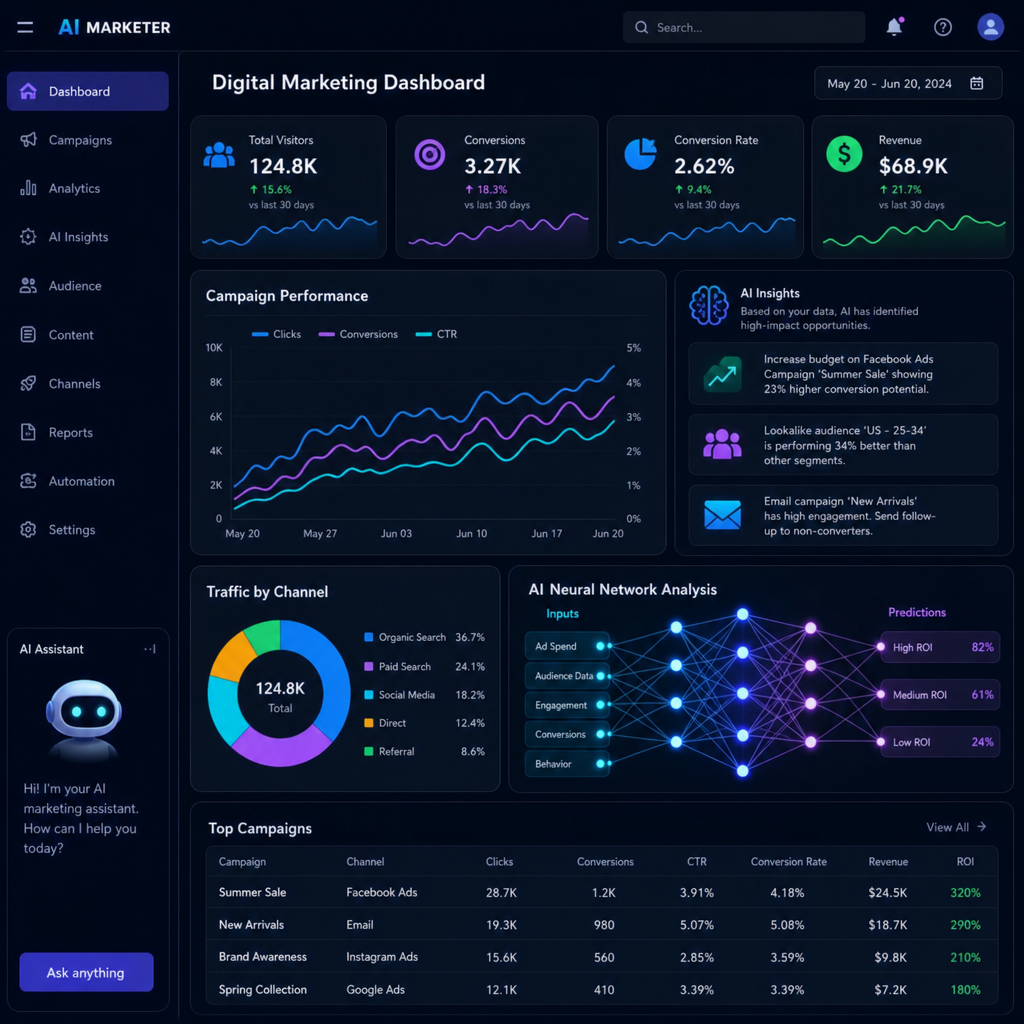
The Evolution: From Automation to Intelligence
Before we dive into actionable strategies, it is crucial to understand the distinction between basic automation and true artificial intelligence. Automation follows predefined rules—if X happens, do Y. AI, on the other hand, learns from data patterns to make predictions, generate new concepts, and improve its performance over time without direct human intervention.
When we talk about digital marketing AI, we are referring to the integration of machine learning, natural language processing (NLP), and generative models into everyday marketing tasks. This shift empowers marketers to move away from tedious manual processes and focus on high-level strategy and creativity.
However, embracing this technology requires a structural shift in how teams operate. Understanding how to integrate generative AI into marketing workflows is the first step toward building a modern, resilient marketing department. It requires auditing current bottlenecks, identifying repetitive tasks, and carefully selecting AI marketing tools that complement your team’s existing skill sets.
Rethinking Strategy: AI-Driven vs Traditional Content Strategy
For decades, content strategy relied heavily on historical data, quarterly planning sessions, and gut instincts. Marketers would look at what performed well last year, conduct manual keyword research, and map out a rigid content calendar.
When comparing an ai-driven vs traditional content strategy, the differences are stark.
The Traditional Approach
- Static Planning: Content calendars are planned months in advance and rarely deviate.
- Broad Personas: Messaging targets broad demographics (e.g., “Millennial homeowners”).
- Reactive Adjustments: Performance is reviewed at the end of a campaign, making it difficult to pivot quickly.
The AI-Driven Approach
- Dynamic Agility: Content adapts to real-time search trends and sudden shifts in consumer interest.
- Hyper-Personalization: AI analyzes individual user behavior to deliver highly specific content at the right moment.
- Proactive Adjustments: Algorithms predict fatigue and suggest optimizations before a campaign’s performance drops.
By shifting to an AI-driven model, you stop guessing what your audience wants and start listening to the data they are actively producing.
Content Generation: Overcoming the Noise
The internet is flooded with content. With millions of blog posts, videos, and social media updates published daily, standing out is harder than ever.

Revolutionizing AI Content Creation
The advent of generative AI has revolutionized ai content creation. Marketers no longer have to stare at a blank screen waiting for inspiration to strike. Today’s AI marketing tools can draft blog outlines, write compelling ad copy, and even generate creative briefs in seconds.
However, the real power lies in utilizing large language models for personalized brand messaging. Instead of blasting a generic email to 50,000 subscribers, large language models (LLMs) can segment that list based on past purchasing behavior, browsing history, and engagement metrics, generating customized email copy for dozens of distinct micro-segments. This ensures that the messaging resonates on a personal level, drastically improving open and conversion rates.
Breaking Through the Clutter
With AI making content creation easier, the risk of digital fatigue is high. Solving content saturation with ai-assisted personalization is the antidote. Consumers do not hate content; they hate irrelevant content.
AI allows you to map the customer journey with incredible precision. By analyzing data points, AI tools can deliver a specific case study to a B2B prospect who just visited your pricing page, or send a dynamic discount code to an ecommerce shopper who abandoned their cart. Personalization at this scale cuts through the saturation, making your brand feel attentive rather than noisy.
Dominating Search Engines: A Step-by-Step Guide to AI-Powered SEO Optimization
Search Engine Optimization (SEO) has always been a data-heavy discipline, making it the perfect candidate for AI integration. Here is a practical, step-by-step guide to ai-powered seo optimization that you can implement today.
Step 1: Semantic Keyword Research and Clustering
Traditional tools give you search volume and difficulty. AI tools analyze the semantic relationship between keywords. Use AI to group thousands of keywords into thematic clusters, allowing you to build comprehensive pillar pages that establish topical authority.
Step 2: Search Intent Analysis
AI excels at reading the search engine results pages (SERPs). Feed your target keywords into an AI tool to analyze the top-ranking pages. The AI can instantly tell you if the search intent is informational, transactional, or navigational, and highlight the exact subtopics your competitors are missing.
Step 3: Content Brief Generation
Instead of manually outlining an article, use AI to generate a comprehensive content brief. Ask your AI assistant to include optimal H2 and H3 tags, LSI (Latent Semantic Indexing) keywords, and recommended word counts based on top-ranking competitors.
Step 4: AI-Assisted Drafting and Optimization
Use AI content writing assistants to help draft the content, but keep a human in the driver’s seat to ensure brand voice and factual accuracy. Once drafted, run the content through an AI SEO optimizer to score your text in real-time, ensuring optimal keyword density and readability.
Step 5: Automated Internal Linking and Metadata
AI plugins can now scan your website’s entire architecture to recommend highly relevant internal linking opportunities. Furthermore, you can use AI to generate dozens of variations for title tags and meta descriptions, A/B testing them to see which yields the highest click-through rate (CTR).
Social Media and Customer Engagement
Social media moves at the speed of light. Keeping up with trends, comments, and direct messages requires tools that operate around the clock.

Managing the Social Ecosystem
When comparing the best ai tools for social media management, it is important to look past basic scheduling capabilities. The best platforms on the market today use AI to determine the exact minute your unique audience is most active. They use computer vision to analyze which color palettes in your images drive the most engagement, and they feature social listening algorithms that analyze brand sentiment across the globe in real-time.
The Rise of Conversational Marketing
The days of frustrating, rigid chatbots that only understand specific commands are over. The integration of natural language processing in conversational marketing has created virtual assistants that genuinely understand context, nuance, and even user frustration.
Modern AI chatbots can seamlessly guide a user through a complex purchasing decision, answer highly specific technical questions, and gracefully hand off the conversation to a human representative when empathy is required. This 24/7 intelligent engagement reduces friction in the customer journey and accelerates the sales cycle.
Data, Analytics, and Real-Time Agility
Marketing has always been a numbers game, but human marketers are limited by how much data they can process. AI thrives on massive datasets, identifying correlations that a human analyst might take months to find.
Forecasting the Future
One of the most powerful applications of modern technology is predictive analytics for customer behavior forecasting. By analyzing past purchase history, website navigation paths, and seasonal trends, AI models can assign a probability score to future actions.
For example, a predictive model can identify which customers have an 80% chance of churning in the next 30 days. Armed with this knowledge, marketers can preemptively launch a targeted retention campaign, offering personalized incentives before the customer even makes the conscious decision to leave.
Streamlining the B2B Pipeline
In B2B marketing, sales and marketing alignment is a perpetual challenge. Automating lead scoring with artificial intelligence bridges this gap.
Instead of assigning arbitrary point values to actions (e.g., +5 points for opening an email), AI lead scoring models analyze thousands of data points to determine true buyer readiness. The system learns from historical won and lost deals, continuously adjusting its algorithms to ensure that the sales team is only spending time on the most highly qualified prospects.
Agile Campaign Management
The “set it and forget it” approach to advertising is dead. Today, maximizing ad spend requires leveraging machine learning for real-time campaign adjustments.
Machine learning algorithms can monitor your Google Ads or Meta Ads campaigns 24/7. If a specific ad creative starts experiencing ad fatigue, or if a competitor suddenly increases their bidding on a core keyword, the AI can automatically shift budgets, pause underperforming assets, and reallocate resources to the highest-converting channels within milliseconds.
Advanced Strategies: Omnichannel and Multimodal AI
As consumer touchpoints multiply—ranging from TikTok and Instagram to email, podcasts, and digital billboards—maintaining a cohesive brand experience becomes immensely challenging.
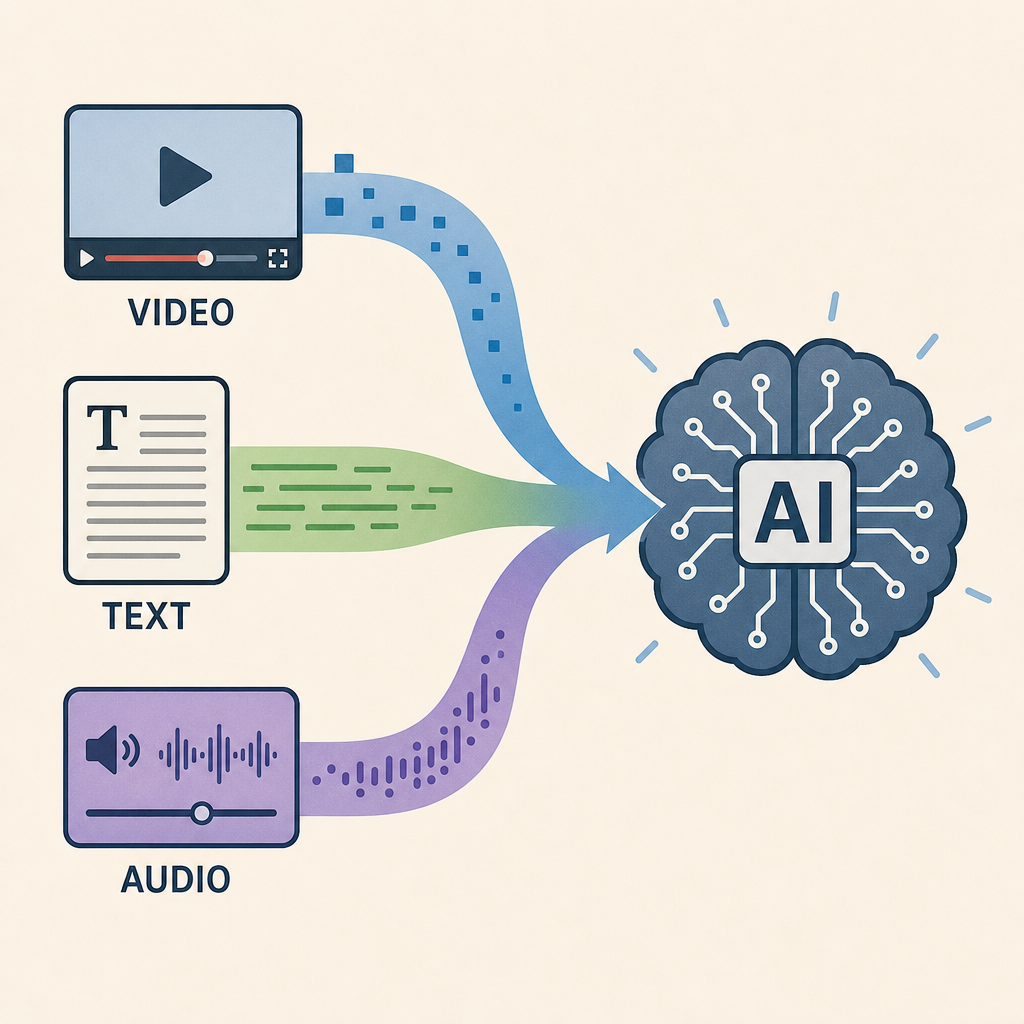
This is where implementing multimodal ai in omnichannel strategies becomes a game-changer. Multimodal AI is capable of processing and generating multiple types of data simultaneously—text, images, audio, and video.
Imagine a workflow where an AI tool ingests a long-form podcast episode (audio). It then automatically generates a written blog post (text), pulls key quotes to overlay onto automatically generated graphics (images), and clips the best 15-second moments into short-form videos for TikTok and Reels (video).
Implementing this level of multimodal AI ensures that your messaging remains perfectly consistent across all channels while exponentially scaling your content output without burning out your creative team.
Proving the Value: ROI and Analytics
Adopting new technology requires investment—both in software costs and team training. Therefore, measuring return on investment for ai marketing transformation is critical to gaining executive buy-in and justifying continued expansion.
To accurately measure AI ROI, you must track both direct and indirect metrics:
- Direct Revenue Impact: Track the conversion rates of AI-personalized emails versus standard emails. Measure the decrease in Cost Per Acquisition (CPA) after implementing machine learning bidding in your ad campaigns.
- Operational Efficiency (Time Saved): Calculate the hours saved by using AI for content drafting, data analysis, and reporting. Multiply those saved hours by your team’s hourly wage to quantify operational cost savings.
- Customer Lifetime Value (CLV): Monitor whether predictive analytics and AI-driven retention campaigns are actively extending the lifecycle of your average customer.
- Content Output vs. Cost: Measure the volume of high-quality assets generated before and after AI adoption, comparing it against freelance or agency costs previously required to achieve similar output.
By establishing clear baseline metrics before integrating AI, you can present a definitive narrative of how the technology is driving both top-line revenue and bottom-line efficiency.
The Human Element: Ethics, Automation, and the Future
As AI becomes more deeply entrenched in the marketing ecosystem, we must confront the philosophical and practical questions it raises.
Navigating the Moral Landscape
The ethical implications of artificial intelligence in advertising cannot be ignored. Because AI models are trained on historical data, they can inadvertently perpetuate existing human biases. If an AI tool is trained on a biased dataset, it may exclude certain demographics from seeing housing or job advertisements, leading to severe legal and reputational damage.
Furthermore, transparency is becoming a major consumer demand. Brands must be careful not to deceive consumers into thinking they are interacting with a human when they are speaking to an AI. Ethical marketing in the AI era requires strict data privacy compliance (like GDPR and CCPA), unbiased algorithm auditing, and a commitment to using consumer data responsibly.
The Elephant in the Room: Job Security
With all these capabilities, the most common question in the industry is: will ai replace digital marketing specialists?
The short answer is no. AI will not replace digital marketers; but digital marketers who use AI will rapidly replace those who do not.
AI is incredibly proficient at executing tasks, recognizing patterns, and generating variations. However, AI lacks genuine empathy, lived human experience, and intuitive strategic vision. It cannot understand the subtle cultural nuances that make a brand campaign emotionally resonant. It cannot negotiate a complex brand partnership or build genuine human relationships with industry influencers.

Securing Your Place in the Industry
For professionals looking to stay relevant, future-proofing marketing careers against automation requires a strategic shift in skill development.
Instead of priding yourself on how fast you can write a standard blog post or manually build a spreadsheet, focus on developing skills that AI cannot easily replicate:
- Strategic Curation: Move from being a “creator” to an “editor and curator.” Learn how to prompt AI effectively and refine its output to match your brand’s unique voice.
- Emotional Intelligence: Deepen your understanding of consumer psychology. AI can tell you what users are clicking, but human marketers are required to understand why they feel compelled to do so.
- Cross-Functional Strategy: Learn how to bridge the gap between marketing, sales, product, and customer service. High-level strategic thinking and relationship building are safe from automation.
- AI Tool Mastery: Become the resident expert in integrating and auditing AI tools within your organization. If you are the person who knows how to train the models, your role becomes indispensable.
Conclusion
Digital marketing in the era of AI is not a fleeting trend; it is a fundamental evolution of how businesses connect with consumers. From solving content saturation with hyper-personalization to utilizing predictive analytics for customer behavior forecasting, AI provides a toolkit of unprecedented power.
However, the key to effective digital marketing campaigns lies not in blindly handing over the reins to algorithms, but in forging a symbiotic relationship between human creativity and machine efficiency. By thoughtfully selecting the right AI marketing tools, respecting ethical boundaries, and continuously upskilling your team, you can build a marketing engine that is not only highly profitable but also profoundly resilient to the changes of tomorrow.
Embrace the technology, lean into your human intuition, and prepare to elevate your digital marketing campaigns to heights previously thought impossible.
Ending with a strong line from IBM Manual:
A computer can never be held accountable, therefore a computer must never make a management decision.
