

In the modern, hyper-connected digital landscape, capturing a user’s attention feels like trying to catch lightning in a bottle. As marketers, we are constantly battling infinite scroll, multiple open browser tabs, and overflowing inboxes. To cut through the noise, you need more than just great products; you need a flawless pacing strategy.
Enter the 3-3-3 rule in marketing, a strategic framework designed to align your messaging with the natural rhythm of human attention.
Whether you are launching a new product, redesigning a landing page, or overhauling your content strategy, this rule acts as a blueprint for user engagement. In this comprehensive guide, we will break down the intricacies of this rule, explore the behavioral science behind it, and show you exactly how to apply it to turn passive scrollers into loyal customers.

Why Do Users Leave Websites Quickly?
It is a common scenario: you spend weeks crafting a beautiful digital marketing campaign, only to check your analytics and see dismal retention rates. This often leads marketers to ask, why do users leave websites quickly?
The answer lies in our increasingly fragmented focus. Recent digital consumer attention span statistics reveal that users form an opinion about a website within milliseconds. If they don’t immediately understand what you are offering and why it matters to them, they will hit the “back” button without hesitation.
This behavior is deeply rooted in the psychology of first impressions in branding. When a user lands on your site, their brain subconsciously asks three questions:
- Am I in the right place?
- What is in it for me?
- What do I do next?
If your design and messaging do not answer these questions instantly, cognitive friction occurs. To combat this, marketers must adopt robust marketing communication efficiency strategies, ensuring that every word, image, and button serves a distinct purpose.
Demystifying the 3-3-3 Rule in Marketing
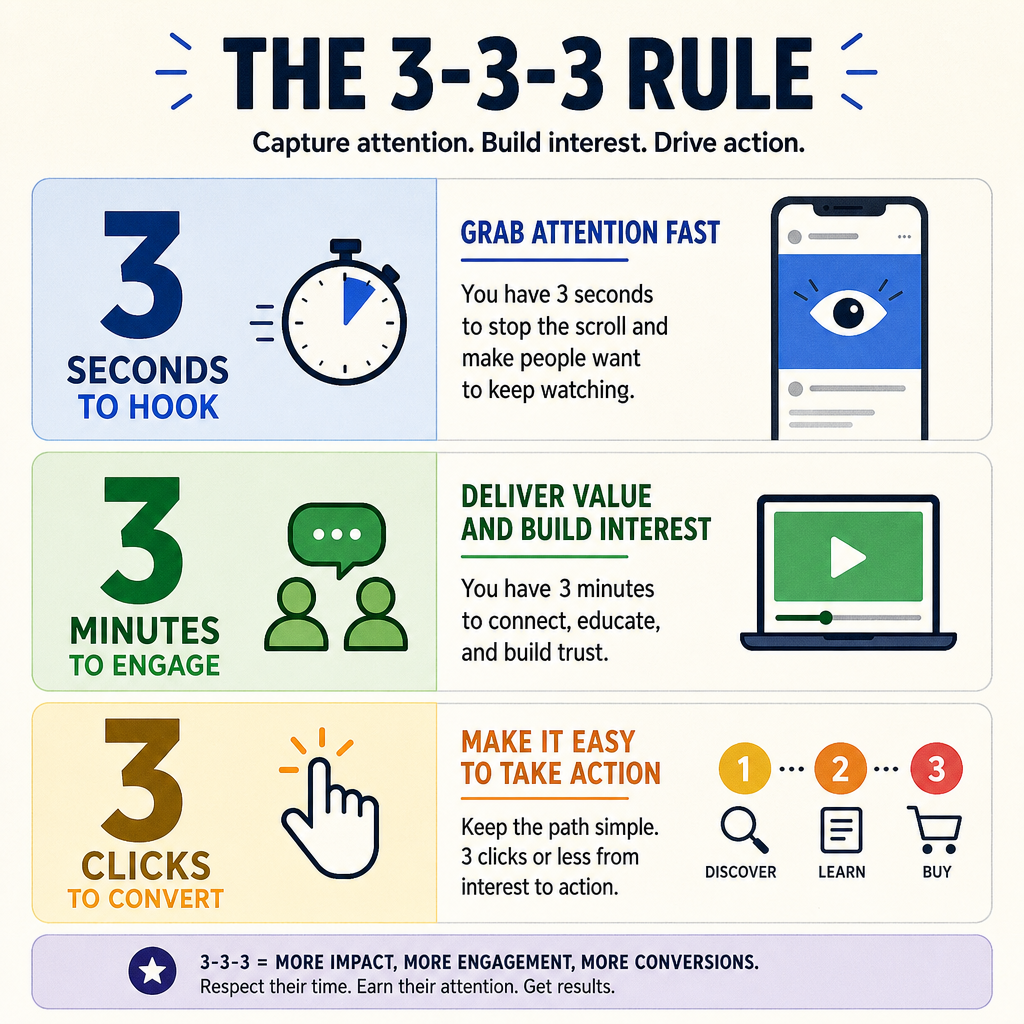
The 3-3-3 rule in marketing breaks user interaction down into three distinct phases of engagement:
- 3 Seconds: To capture attention and hook the user.
- 3 Minutes: To build interest and deliver deep value.
- 3 Actions (or Clicks): To guide the user toward a seamless conversion.
Let’s explore each phase in detail and look at how you can optimize your assets for maximum impact.
Phase 1: The First 3 Seconds (The Hook)
You have exactly three seconds to convince a visitor to stay. This is the make-or-break moment of your entire campaign.
When discussing rapid user assessment, marketers often compare the 3-3-3 rule vs 5-second test. While the 5-second test measures whether a user understands your core message after viewing a page for five seconds, the 3-second rule is purely about attention and visual impact. It is the raw, visceral reaction your page provokes.
To win these crucial three seconds, you must understand how to craft a compelling hook. Your headline should be punchy, benefit-driven, and hyper-relevant to the ad or search query that brought the user there.
Furthermore, you must master website landing page visual hierarchy. A user’s eyes naturally follow specific patterns (like the F-pattern or Z-pattern). Place your most critical elements—your headline, a striking hero image, and your primary call to action—along these natural eye-paths.
Actionable Tips for the First 3 Seconds:
- Implement a value proposition clarity framework: Ensure your main headline states exactly what you do, who you do it for, and the primary benefit. Eliminate clever jargon in favor of absolute clarity.
- Declutter above the fold: Remove unnecessary navigation links or heavy blocks of text that overwhelm the eye.
- Use directional cues: Employ images of people looking toward your headline, or subtle arrows pointing to your most important text.
Phase 2: The Next 3 Minutes (The Engagement)
Congratulations, you survived the first three seconds! The user is intrigued. Now, you have roughly three minutes to deliver on the promise you made in your hook.
This phase is where your content strategy truly shines. Three minutes of reading equates to roughly 600 to 800 words. In this timeframe, you need to build trust, present a solution to their pain points, and leverage brand storytelling for engagement. People connect with narratives, not just feature lists. Frame your customer as the hero of the story and your product as the guide that helps them achieve their goals.
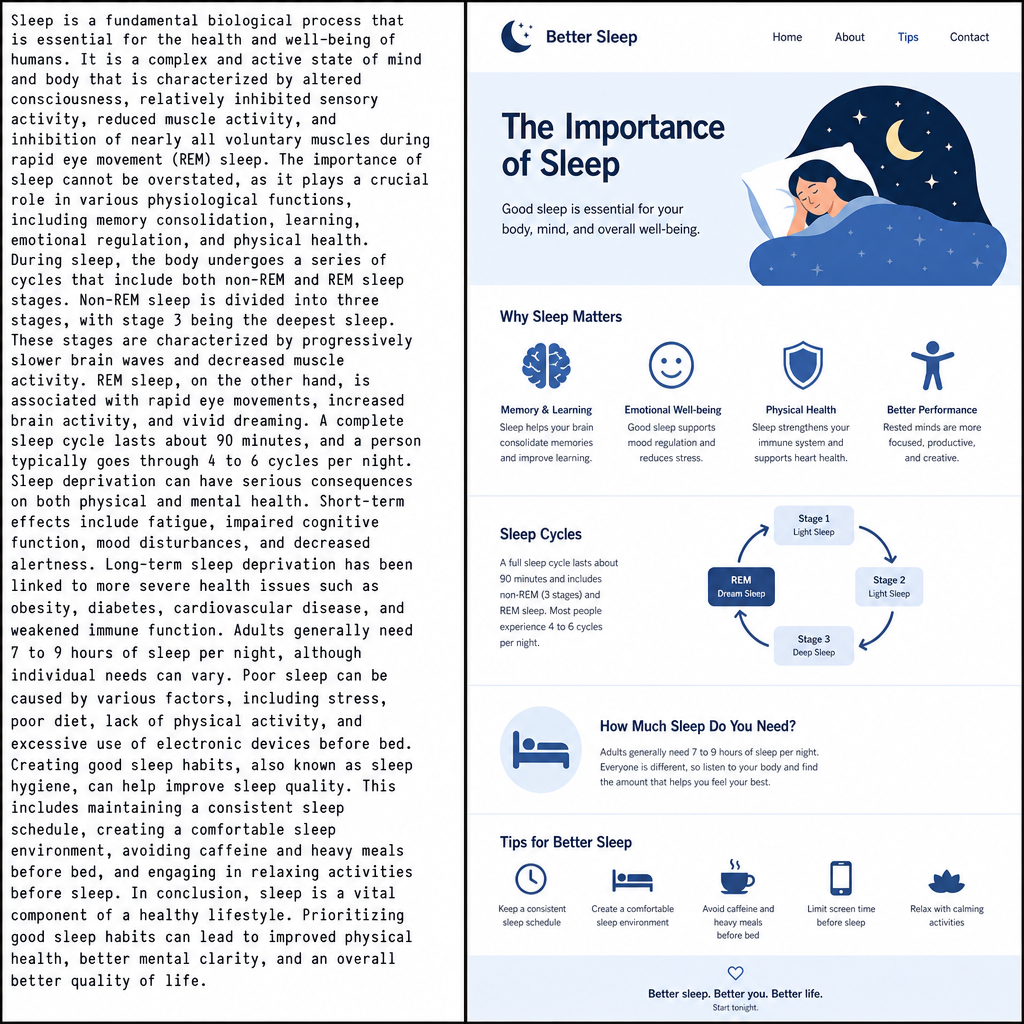
However, modern users rarely read word-for-word; they scan. Optimizing content for scannability is non-negotiable for improving user retention on blog posts and landing pages.
Actionable Tips for the 3-Minute Engagement Phase:
- Use descriptive subheadings: Break your text into logical, bite-sized sections. A user should be able to understand the gist of your page just by reading the H2s and H3s.
- Leverage bullet points: Condense complex information into digestible lists (just like this one!).
- Incorporate multimedia: Break up text walls with relevant images, infographics, or short video clips to maintain visual interest and reduce cognitive load.
- Focus on pacing: Transition smoothly from acknowledging the user’s problem to introducing your solution, backing it up with social proof (like testimonials or case studies).
Phase 3: The 3 Core Actions (The Conversion)
The final “3” in the rule dictates that once a user is convinced, it should take them no more than three steps (or clicks) to complete the desired action. Whether that is making a purchase, signing up for a newsletter, or booking a demo, friction is the enemy of conversion.
This phase relies heavily on information architecture for high conversions. If a user has to hunt for your pricing page, fill out a 15-field form, and navigate through a cluttered checkout process, they will abandon the journey, regardless of how great your storytelling was.
Effective call to action placement is vital here. Your Call to Action (CTA) shouldn’t just live at the bottom of the page. It should be easily accessible at every stage of the user’s thought process.
Actionable Tips for the 3-Action Phase:
- Audit your checkout/signup flow: Walk through your own conversion process. Can it be done in three clicks or fewer? If not, ruthlessly cut unnecessary fields or pages.
- Use floating or sticky CTAs: Keep the primary action button visible as the user scrolls down the page.
- Offer guest checkout: For e-commerce, forcing users to create an account is a massive point of friction. Always provide a fast, frictionless path to purchase.
Integrating the Rule Across Channels
The true beauty of the 3-3-3 rule in marketing is its versatility. It is not just for landing pages; it is a holistic philosophy that can elevate your entire digital presence.
Reducing Bounce Rates Through Clear Messaging
Bounce rates are a direct reflection of unmet expectations. By applying the 3-3-3 rule, you align user intent with your page’s delivery. When your hook is strong (3 seconds) and your content is scannable and valuable (3 minutes), users have no reason to leave immediately. Reducing bounce rates through clear messaging ultimately signals to search engines that your page is high-quality, which can positively impact your SEO rankings.
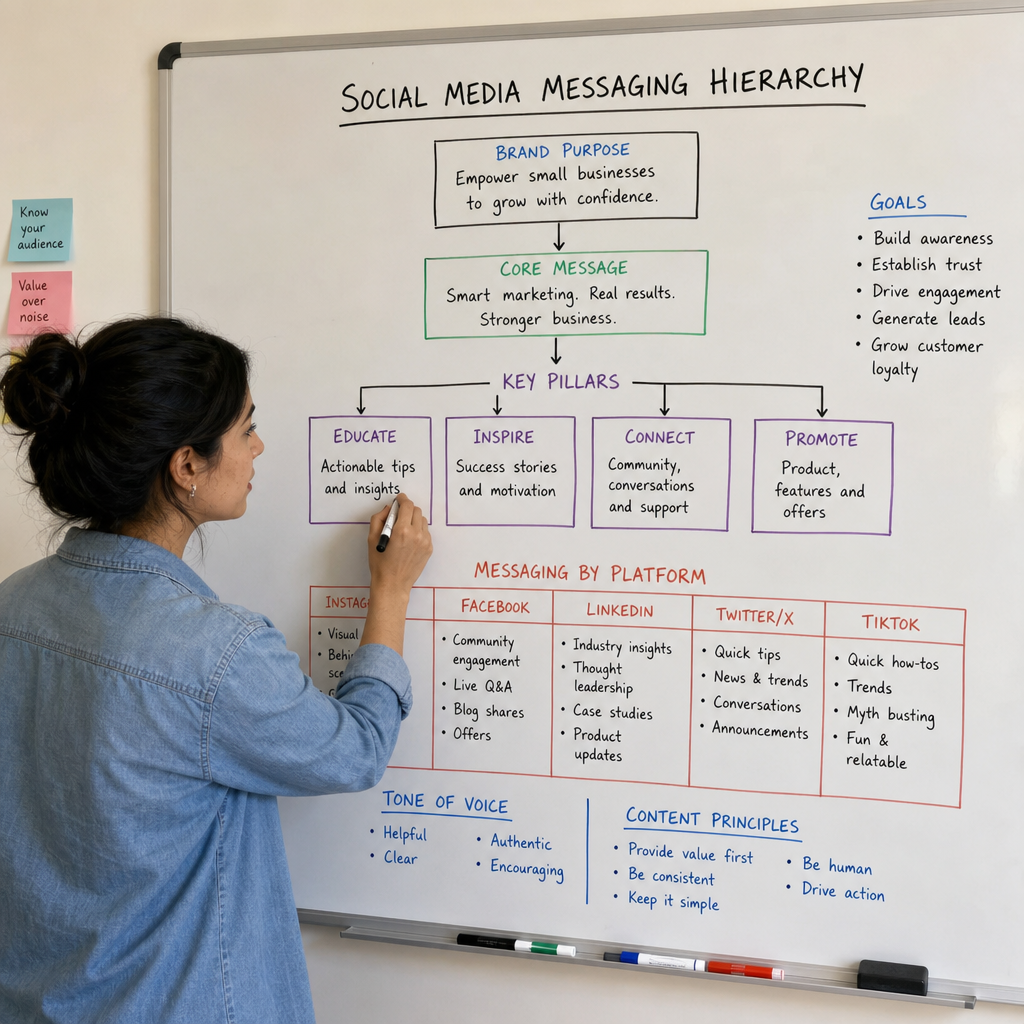
Messaging Hierarchy for Social Media
Social media platforms are the ultimate battleground for attention. Applying a strict messaging hierarchy for social media ensures your posts align with the 3-3-3 framework.
- 3 Seconds: The scroll-stopping visual or video hook.
- 3 Minutes (Adapted for social as 30 seconds): The engaging caption, carousel swipe, or short-form video that delivers immediate value.
- 3 Actions: The link in bio, the double-tap, or the comment prompt.
By treating every tweet, LinkedIn post, or Instagram Reel as a micro-version of this rule, you maximize your chances of stopping the scroll and earning a click.
Common Pitfalls to Avoid
Even seasoned marketers can stumble when trying to implement this framework. Here are a few common mistakes to watch out for:
- Burying the Lede: Don’t wait until the third paragraph to explain what your product does. In the digital world, suspense does not sell; clarity does.
- Visual Clutter: A confused mind always says no. If your landing page has five different competing colors, pop-ups, and an autoplay video, you will fail the 3-second test instantly. Keep it clean.
- Weak CTAs: “Submit” or “Click Here” are uninspiring. Use action-oriented, value-driven text like “Get Your Free Marketing Audit” or “Start Growing Today.”
- Ignoring Mobile Users: The 3-3-3 rule is even more critical on mobile devices, where screens are smaller, and patience is thinner. Ensure your site loads quickly and that your visual hierarchy translates seamlessly to a vertical screen.
Conclusion: Mastering the Art of Pacing
In a digital marketing landscape characterized by fleeting attention spans and endless options, you cannot afford to waste a single second of your audience’s time.
The 3-3-3 rule in marketing is powerful because it respects the user. It acknowledges that their time is valuable, delivering clarity immediately, value consistently, and a path to action effortlessly.
By taking the time to craft compelling hooks, weaving engaging brand stories, and streamlining your user architecture, you do more than just capture attention—you build trust. Audit your current landing pages and content strategy today. Are you passing the 3-second test? Are you providing 3 minutes of undeniable value? Are your conversions no more than 3 clicks away? Master this rhythm, and you will turn casual visitors into lifelong brand advocates.
